

Package Management
How File Shares for OSS Packages Create More Problems Than They Solve
If you’re managing projects that rely on multiple teams delivering consistent components, you’ve probably noticed the chaos that comes from storing build artifacts and libraries in shared folders. Each team has its own way of organizing files, versions get mixed up, and no one really knows which asset the project should be using.
It’s totally understandable why teams lean on file shares: they’re quick, familiar, and don’t require anyone to change how they work. But when every team sets up its own structure, disconnected shares multiply, and consistency vanishes. That leads to fragile pipelines, audit gaps, duplicated effort, and constant scrambling to find “the right file.” What started as a convenient shortcut ends up slowing teams down and hiding risks.
A centralized system fixes this by replacing scattered shares with a single, secure source of truth. It provides oversight, transparency, and automation, keeping versions consistent and governance in place without slowing teams down.
In this article, we’ll explore the risks of isolated package management, why centralization works, and how ProGet helps keep delivery predictable.
The Risks of Managing Packages in Isolation
File shares feel fast, flexible, and familiar. Anyone can upload or download files, and each team can follow its own conventions. But as projects grow, that flexibility starts to backfire. Inconsistencies multiply, builds break, and alignment across teams gets tricky.
⚠️ Version conflicts: Teams often use their own naming and versioning rules, creating mismatched builds and fragile CI/CD pipelines. Packages get duplicated across shares, registries, and local machines. Pipelines are usually set up per team, so fixing these issues takes manual effort and slows everyone down.
⚠️ Duplication: Without a central inventory, teams sometimes recreate packages that already exist. Metadata gets scattered, auditability suffers, and developers end up rebuilding things they didn’t need to. Multiple copies mean inconsistent approvals, security gaps, and growing technical debt.
⚠️ Storage challenges: When every team keeps its own registry or artifact location, storage bloats. Cloud costs and operational overhead climb, cleanup becomes a headache, and pipelines slow down because of inconsistent content and access rules. Without standardization, keeping things running smoothly becomes a major drain on resources.
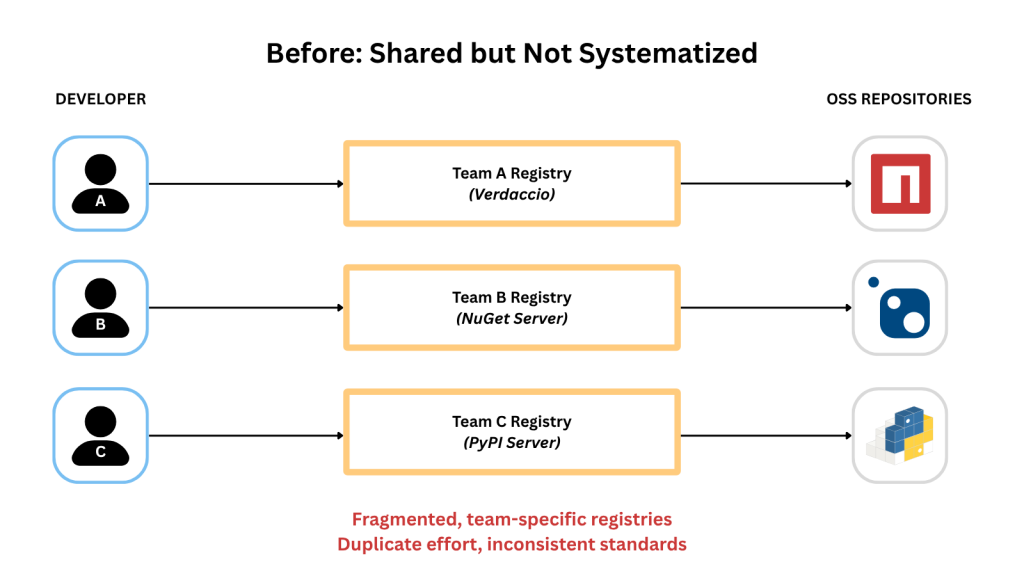
The result is predictable: more packages, more versions, and more confusion. The root cause? Isolated practices and a lack of structure. The solution: a centralized, governed package management system. A single, traceable source of truth providing visibility, oversight, and automation.
Centralization: The Fix for Fragmented Package Practices
A central repository brings order to the chaos. Consolidating isolated file shares into one trusted source gives all teams a single place to publish and consume packages, with consistent versioning and full visibility. Governance adds role-based access, approval workflows, and retention policies, stopping shadow IT, version sprawl, and accountability gaps. Curated feeds and pre-approval workflows make sure only trusted packages reach production.
✅ Duplication disappears: One stored copy can be referenced across teams. Centralized metadata, approval trails, and usage tracking make it easy to see who created or approved a package, where it’s used, and whether it meets license and security requirements. Audit headaches from scattered logs become a thing of the past.
✅ Distribution is more efficient: On-demand serving and caching keep storage lean and infrastructure scalable. Unified audit logs track every download and deployment, and multi-feed support lets workflows scale across teams, languages, and environments without slowing performance.
✅ CI/CD becomes easier: Standardized configurations make builds predictable and repeatable. Repositories scale naturally, maintenance is simpler, and teams spend more time building software instead of managing fragmented setups.
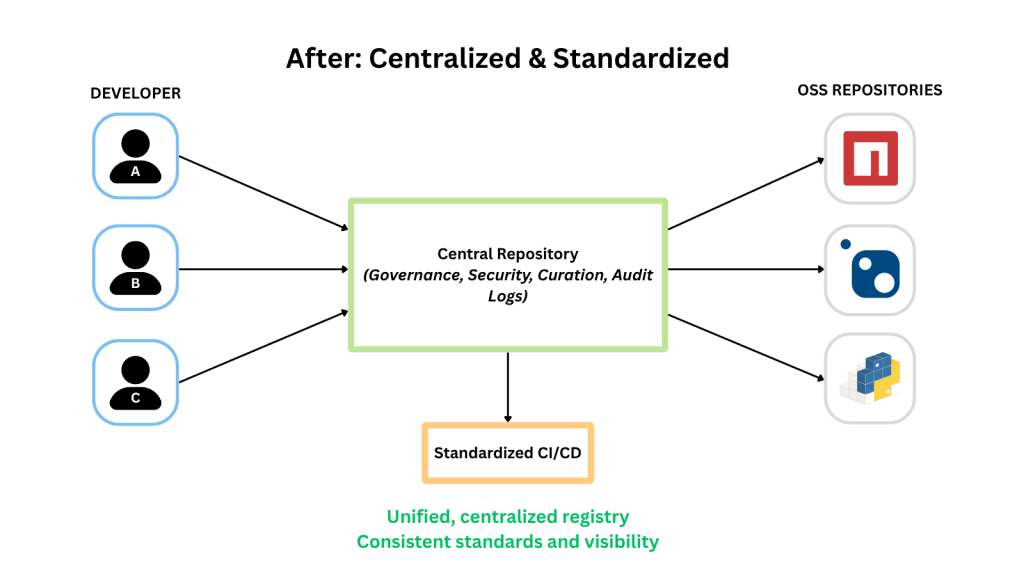
Centralization eliminates the risks of file shares. Every package is stored, governed, and distributed from a verified source of truth. Version conflicts vanish, duplication ends, and storage stays lean. Fragmented file shares are replaced by predictable, secure, and scalable package management. ProGet can help implement this at an enterprise level.
Centralizing Package Management with ProGet
ProGet provides a single source of truth for publishing and consuming packages. This reduces confusion, encourages reuse, and standardizes workflows. Role-based access, promotion workflows, and retention policies prevent shadow IT and enforce compliance. Curated feeds, approvals, and organization-wide policies secure the software supply chain, while centralized metadata, approval tracking, and usage analytics support proactive risk management. Multi-feed support and CI/CD integration allow package workflows to scale seamlessly across teams and projects.
Centralization with ProGet brings measurable benefits:
⭐ Faster delivery: Teams spend time building software, not tracking down files.
⭐ Improved security: Governance reduces exposure and ensures only trusted packages are used.
⭐ Clear ownership and visibility: Unified standards and tracking streamline collaboration.
⭐ Scalable infrastructure: Supports growth and innovation over time.
Scaling Confidently Through Centralization
File shares are easy, but risky. As teams grow, isolated practices cause version conflicts, duplication, wasted storage, audit headaches, fragile builds, and scaling failures.
Centralization creates a unified, secure, and scalable ecosystem. With ProGet, teams can eliminate these risks while strengthening auditability, security, and scalability across the organization.
If this article resonates with you, check out our guide “Package Management at Scale”. It helps you assess your current workflows and offers a practical roadmap for building a secure, scalable package management strategy across all your teams. Read the guide online or download your free copy now!
Or, take the next step and implement a CMPR solution in your own organization using ProGet. You can start a 30-day free trial of ProGet Basic and see how centralized package management streamlines workflows, improves compliance, and boosts developer productivity firsthand.
