

Package Management
Why Package Management Fails Without Governance
This article is part of our series on Package Management at Scale, also available as a chapter in our free, downloadable eBook
Managing packages across fragmented, siloed repositories leads to duplicated effort, poor visibility, and inconsistent standards, which is why many organizations turn to centralization. But without clear structure and oversight, it can just as easily magnify existing problems. Instead of improving workflows. This includes inconsistent naming and versioning, unclear approval processes, and exposure to unvetted or irrelevant packages, all of which can lead to issues like integration failures, security vulnerabilities, or wasted developer time.
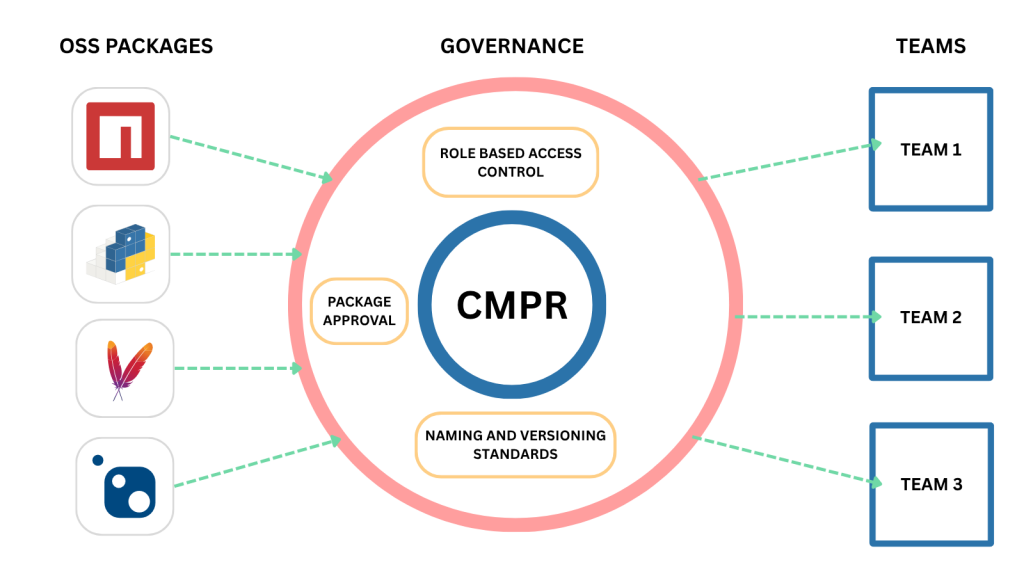
Centralization without structure can quickly become chaotic. For the most part, it’s even worse than siloed repositories. These at least provide clear ownership and boundaries. A strong governance model brings order through clear standards for naming, versioning, approval, and access. When applied to a centralized infrastructure, these rules can be automated and enforced at scale, making policies consistent and reducing the burden on individual teams. Governance isn’t about restricting teams or slowing them down; it’s about enabling greater autonomy. It prevents developers from using unapproved or vulnerable packages, helping teams avoid risk and move faster. Done right, it doesn’t create bottlenecks—it removes them.
In this article, we’ll talk about how governance fits into the broader Centrally Managed Package Repository (CMPR) framework and explore why it matters in modern software organizations. We’ll also highlight the pitfalls of centralization without governance and show how to avoid them by pairing structure with scalability. Finally, we’ll share practical steps for implementing package governance in your organization.
Why Governance Matters
Well-established governance provides structure and safety while allowing teams to move fast and optimize locally. It’s the foundation that enables siloed development to thrive without compromising on security, quality, or compliance. When done right, governance becomes a strategic enabler, not a bottleneck.
This isn’t a new concept. In fact, some of the most successful and scalable systems in the digital world have already solved this puzzle:
- GitHub: Software development is inherently decentralized, thousands of contributors, repositories, and ideas in motion at once. But GitHub’s model works because of centralized rules around version control, permissions, code reviews, and contribution workflows. This structure allows for innovation without chaos.
- App Stores: Anyone can build an app, but not every app gets published. Centralized control through app review guidelines, security policies, and distribution standards ensures that the overall ecosystem remains secure and trustworthy. Developers enjoy creative freedom, but within guardrails that protect users and platform integrity.
These systems succeed because they strike a critical balance. They offer:
- Clear rules and structure to maintain safety, consistency, and trust
- Freedom and autonomy for contributors to move fast and experiment locally
- Global alignment without the need for constant oversight or micromanagement
In this way, governance doesn’t stifle decentralization, it unlocks it. It allows decentralized teams to scale confidently, knowing that a shared framework is in place to catch errors, uphold standards, and protect the system as a whole. It’s the invisible scaffolding that supports innovation at scale.
What Governance Enables in Package Management
In a governed package ecosystem, teams can move quickly and make local decisions without compromising the integrity of the broader system. Within this model, teams can independently:
- Create, consume, and promote packages based on their needs, enabling rapid iteration and innovation.
- Approve packages “within their team” while ensuring alignment with organization-wide standards such as security scanning, license compliance, and immutability guarantees.
- Operate with autonomy, but always within clearly defined guardrails that maintain safety, visibility, and control across the organization.
When well-designed and automated, governance removes more friction than it adds. By embedding policy enforcement and quality checks into the development lifecycle, it:
- Prevents global risk by catching vulnerabilities, policy violations, or misconfigurations before they spread
- Encourages reuse and consistency, reducing duplication and improving collaboration across teams
- Supports quality at scale, allowing hundreds or thousands of teams to build, share, and deploy with confidence, without slowing them down
The result is a system where innovation is distributed, but responsibility is shared. Governance becomes the enabler of speed, safety, and scale. Not an obstacle to it.

Core Areas That Require Governance
For governance to be effective, it must go beyond policy documents and tribal knowledge. It needs to be embedded into the tooling and enforced automatically. The goal is to build trust in the system by making sure standards are not only defined but upheld. Key areas of focus include:
- Role-Based Access Control (RBAC): Define who can take what actions. Publishing, promoting, or approving packages should be tied to specific roles. This ensures the right people have the right level of control, and nothing slips through unreviewed.
- Naming and Versioning Standards: Enforce consistent naming conventions and semantic versioning (SemVer) to improve discoverability and predictability. Standardization here reduces confusion and makes integration across teams seamless.
- Approval Workflows: Implement automated gates that packages must pass before being approved or promoted. These can include checks for known vulnerabilities, license compliance, immutability, and required peer reviews, all baked into the development pipeline.
- Blocking Unsafe Automation: Prevent potentially dangerous operations, like auto-deploying applications that rely on unverified or missing dependencies. These safeguards ensure that automation accelerates progress without introducing hidden risks.
Governance can’t be a “best effort” or an honor system. It must be enforced through the tooling itself reliably, consistently, and invisibly. When policy is automated, it becomes a seamless part of the development workflow, not an afterthought or obstacle.
Governance Anti-Patterns
Good governance can enable scale and security. But poorly implemented governance often backfires, creating friction, frustration, or failure. Here are three common traps organizations fall into—and how to avoid them:
❌ Best-Effort Governance (No Automation): Policies that exist only in documentation or rely on team discipline may work at a small scale, but they collapse as complexity grows. Without automated enforcement:
- Semantic versioning (SemVer) often breaks because there’s no automated validation or enforcement, so developers may unintentionally skip or misuse version increments.
- Package immutability isn’t guaranteed since artifacts can be overwritten or changed after publishing without controls in place.
- Teams may publish untracked artifacts instead of properly versioned, reusable packages because manual processes are error-prone and lack centralized oversight.
These problems are especially prevalent in organizations using tech-specific or siloed tools, which typically lack built-in support to enforce policies through code or CI/CD pipelines. To truly solve governance challenges, policies must be integrated into tooling and enforced automatically, not just documented or recommended.
❌ Rigid Governance (No Flexibility): Overly strict governance that leaves no room for context or exceptions is often counterproductive: organizations assume tight control ensures compliance, but inflexible policies frequently cause teams to work around the system entirely, leading to:
- Shadow IT and rogue workflows that create security blind spots and increase operational risks
- Malicious compliance that checks the box without real accountability, undermining the effectiveness of governance
- Developers bypassing systems out of frustration, resulting in fragmented processes and lost visibility
Effective governance supports flexibility, not just control. Look for tools that allow:
✔ Customizable role-based access control (RBAC) to tailor permissions based on team needs and reduce unnecessary blockers
✔ Well-audited manual overrides for special cases, providing a controlled way to handle exceptions without sacrificing accountability
✔ Local exceptions that don’t compromise global standards, enabling teams to stay agile while maintaining overall compliance
This balance allows teams to move fast without sacrificing oversight.
Striking the Right Centralization Balance
A separate but equally important consideration is the challenge of centralization itself. Centralization must be right-sized to avoid risks at both extremes:
- Too little centralization leads to fragmentation, duplicated work, and security gaps because teams operate in silos without shared standards or visibility.
- Too much centralization creates bottlenecks, frustration, and top-down resentment as rigid controls slow development and ignore local needs.
The ideal approach is federated governance, combining:
- Global policies for alignment and safety, ensuring consistency and reducing organizational risk.
- Local overrides for team-level optimization and agility, allowing flexibility to adapt without compromising overall standards.
Again, non-centralized tooling may lack the nuance to support this balance, forcing organizations to choose between control and velocity. Smart governance is not about locking things down. It’s about enabling safe, scalable autonomy.
Best Practices for Package Governance
Effective package governance is about creating clarity, safety, and scalability in a decentralized world. The goal is to align teams around shared standards without blocking innovation or autonomy. To strike the right balance, follow these core principles:
✅ Global Policies to Protect the Organization: Define clear rules for licensing, vulnerability thresholds, immutability, and promotion workflows. These guardrails ensure compliance, consistency, and security across the entire software supply chain.
✅ Local Customization to Enable Speed and Innovation: Empower teams to adapt governance to their needs, whether that’s team-specific access controls, custom feeds, or override paths for edge cases. Flexibility ensures governance doesn’t become a bottleneck.
✅ Automation to Enforce Governance at Scale: Rely on tooling, not tribal knowledge. Use your package manager, CI/CD pipelines, and policy engines to automatically enforce standards and prevent drift, mistakes, or oversights.
✅ Centralized Architecture that Supports Governance: Centralization isn’t the goal, it’s the foundation. A well-designed, centralized package management system enables visibility, traceability, and control while supporting distributed development.
When these practices are in place, governance becomes an accelerator, not a blocker. Centralization stops being a liability and becomes a strategic advantage, helping teams move more safely, and with more confidence.
Governance that Scales with Your Organization
Without clear, automated governance, centralized package infrastructure can quickly become a liability. Inconsistent standards, manual approvals, and ad hoc workflows introduce risk at scale. This ranges from security vulnerabilities to compliance failures to shadow IT. Worse, rigid or poorly implemented governance can erode trust and lead to workarounds that result in a fragmented ecosystem where teams are either slowed down or left to fend for themselves.
The solution is a thoughtful, tooling-driven governance model that balances control with autonomy. By defining global policies, enabling local customization, and enforcing rules automatically, organizations can scale safely without sacrificing speed. Centralized architecture becomes the foundation for decentralized innovation. A system where teams move fast, stay aligned, and build with confidence.
This article covered a lot of ground, so save this page in case you’re ever in need of a refresher. Better yet, sign up for a copy of our centrally managed package repository guide, “Package Management at Scale”. It’s crammed with everything on this page, along with detailed dives into package curation, distribution, and centralization, in addition to an assessment of your team’s current maturity, giving you a head start in creating a scalable foundation. Download your free copy today!
Not sure where to start? Our experts can help. Book a free 15-minute guided assessment to get personalized insight into your package management practices, and clear next steps for reducing risk.
