

Lean Platforms
Why Real-Time Information is Key to Modern Software Development
This article is part of our series on Lean Platforms, soon featuring as a chapter in our up and coming free, downloadable eBook
Real-time information (RTI) is essential for any modern organization looking to deliver software and compete in the modern market. Lean Platforms is powered by RTI. Having RTI means always knowing the status of builds, deployments, and releases as they happen. Instead of waiting around for updates or sifting through logs, teams get instant info, which means faster decision making and more reliable software delivery overall. It might seem tools like Jira, GitHub, GitLab, or Jenkins already provide this visibility, but on their own they leave you with fragmented views instead of the unified insights that Real Time Information can.
Without RTI, development loses steam. If a team green-lights a deployment based on a status report from yesterday, they might miss a last-minute build failure or a critical bug flagged in a separate tool, leading to poor decisions such as releasing code too early or skipping needed testing that ultimately result in flawed delivery of the application. Problems like this mean your software supply chain takes a hit, leading to delayed releases, technical debt, or even outages that hurt customer satisfaction and your competitive edge in the market.
In this article, we’ll break down why working without real-time information in a software supply chain slows down development, and ultimately results in missed deadlines and lower software quality. We’ll then show you how BuildMaster can help you centralize real-time data, keeping your team and stakeholders in the loop at all times.
Why Real-Time Information is So Important
Imagine a military force operating without radios, relying on runners and delayed reports, against one with real-time information. The difference is night and day. With radios, commanders receive battlefield intelligence instantly, letting them make the faster decisions that would defeat a slower, less informed opponent. For instance, identifying an exposed flank in real time, striking fast to win decisively.
With radios, armies are more agile, and more effective. The advantage isn’t just about technology—it’s about the ability to act on real-time information.
Fast forward to business, before email came along. They relied on memos and faxed reports, which took days to circulate. RTI through email changed everything by allowing instant communication of complex, time-sensitive information. This improved decision-making, and collaboration across entire enterprises. Then came Slack and instant messaging, speeding RTI even further.
There was a time when people thought email was just for big organizations—until they realized they couldn’t compete without it. The same is happening with RTI in the software supply chain. Picture a team deciding to deploy a feature based on a build status from last night—only to find out too late that a critical test failed in the meantime, tanking the release.
Organizations invest in Lean Platforms because it delivers insights in real time, allowing teams to act quickly and confidently to reduce downtime and accelerate delivery. Without it, teams struggle to answer basic questions:
❓ Is my build ready for testing?
❓ What’s holding up our next release?
❓ What changed since the last deployment?
Using a Lean Platforms methodology solves this by centralizing data into a command center that provides instant answers. It doesn’t just make RTI possible; it makes it the norm.
For modern organizations, the question isn’t if they need real-time information; it’s how they can manage without it.
Why Organizations Struggle With Scattered Information
For a lot of organizations, waiting for answers feels “good enough”, but only because it’s all they’ve ever known. Teams and stakeholders aren’t used to expecting real-time updates. But in modern development, “good enough” just isn’t good enough anymore. These delays slow down projects and hurt software quality. At first, these small inefficiencies may not seem like a big deal. But eventually these delays start stacking up:
⚠ Testers don’t know what’s ready for testing, so they sit idle, slowing down release cycles.
⚠ Developers waste time answering status questions instead of focusing on writing code.
⚠ Simple blockers like a missing approval or a small config change hold up releases because no one has clear, real-time visibility across multiple specialized tools.
⚠ Troubleshooting becomes a guessing game. Teams may waste time chasing issues that were already resolved, or miss new problems that are emerging, further delaying progress.
⚠ Deployments get riskier when outdated info green-lights old code—yesterday’s “all clear” misses today’s patch, landing buggy releases in production.
Eventually, many organizations realize that their biggest issue isn’t a lack of tools; it’s a lack of visibility into those tools. With so many disconnected systems, each doing its own thing, it creates silos that make it hard for teams to get the full picture.
At this point, the organization realizes the pain of not having real-time information, so they start looking for solutions; often turning to tools or solutions to bring everything together into a single, real-time view.
Dead-End Fixes for the RTI Gap
The problem isn’t a lack of tools; it’s that they’re too disconnected. At first, the delays don’t seem like a big deal, but as teams grow, those small inefficiencies add up. Organizations try to fix it, but they often fall into common traps that don’t solve the real problem. Instead of moving forward, teams get stuck putting out fires.
🚫 Antipattern 1: Cross-Training Everyone on Every Tool
Some teams think the problem is just a lack of training, rather than misaligned tooling. They adopt a “Just train them” mindset, assuming “developers should just learn Jira” or that “stakeholders should just figure out Jenkins.” They assume that if everyone knows how to use every tool, they’ll naturally have a full view of the process.
Why it Fails: Knowing the tools doesn’t fix scattered, outdated info. If data isn’t centralized, you risk checking one tool while something changes in another — leaving you a step behind. Picture toggling between five screens—by the time you hit the fifth, the second’s already changed. You’d have to cycle nonstop to keep up, and even then, it’s not real-time; it’s an unreliable nightmare. It’s not about whether stakeholders can use Jira; it’s about not needing to. Real-time info only works when it’s all in one place.
🚫 Antipattern 2: The DIY Dashboard
Some may decide to create a custom dashboard to centralize information from multiple tools. I mean, it sounds like a smart idea on paper, right? It’s tailored to the team’s exact needs, and at first, it seems to solve the visibility problem.
Why It Fails: Maintaining a custom dashboard is painful. Reality hits when every API tweak or tool update means more tinkering; re-configuring feeds just to keep the real-time data flowing. It’s a maintenance mess.
Smaller teams don’t have the resources to keep up, and instead of speeding up development, the dashboard becomes yet another bottleneck.
🚫 Antipattern 3: The All-in-One Tool Trap
Some teams try to use a single tool like GitHub or GitLab to do everything: source control, CI/CD, deployments, and issue tracking.
Why It Fails: Tools like GitLab are great for streamlined development workflows, but can’t provide a unified, real-time view across all development activities. While GitLab offers features such as Analytics Dashboards and Insights, these are often siloed and update on a scheduled interval rather than in real-time.
Build statuses and deployment logs may reflect a delay because they are processed asynchronously, and issue tracking shows the last recorded state rather than the instantaneous project status. This leaves PMs and executives guessing, or asking “what’s happening now?” The fix isn’t a do-it-all monolith; it’s specialized tools that integrate well together.
Buildmaster – Lean Platforms Command Center for Delivering RTI
Every tool in the software supply chain; Jira, GitHub, Jenkins; was built for a specific task, not for representing the entire delivery pipeline:
- Jira handles project planning but doesn’t track builds or deployments.
- GitHub manages source control but doesn’t provide release insights.
- Jenkins automates builds but lacks visibility into the full application lifecycle.
Organizations often recognize this visibility gap and try to fix it, whether by building custom dashboards or relying on a single “all-in-one” tool. But these solutions come with their own headaches. Custom dashboards require constant upkeep, and all-in-one tools rarely meet the needs of both developers and stakeholders.
BuildMaster offers a simpler, less painful solution. It integrates with your existing tools; CI/CD, source control, automated testing, and issue tracking, bringing everything together into one centralized dashboard.
Unlike pieced-together dashboards or standalone tools like GitHub, BuildMaster provides a single, real-time view of your entire software supply chain. This makes it easier for both technical and non-technical teams to stay aligned without the overhead of maintaining a custom solution.
How Buildmaster’s Model Solves the Problem
Buildmaster’s stakeholder-friendly model is designed to help everyone, from developers to stakeholders, access RTI without having to dig through multiple tools or systems. It does this by organizing everything into four key elements.
⭐ Applications: Act as the central hub, connecting your source control, CI/CD, and issue tracking tools all in one place. They can integrate with multiple repositories and tools like Jenkins, TeamCity, GitHub, and Jira. This makes it easier for stakeholders to get clear, real-time information about development progress, without having to dig through each individual tool.

⭐ Releases: a planned set of changes moving through the deployment pipeline, using real-time information to track progress. They give teams visibility and control over what’s being deployed and when, helping everyone stay on the same page throughout the process.

⭐ Builds: A snapshot of code compiled and deployed for testing before production. Each build gives developers a view of specific code changes, test results, and pipeline progress, while stakeholders can track what’s moving toward production. Unlike Jenkins’ build logs or GitHub’s commit history, BuildMaster provides this all in one place, instantly. No more digging through different tools to answer “What’s in this build?” or “Is it safe to deploy?”
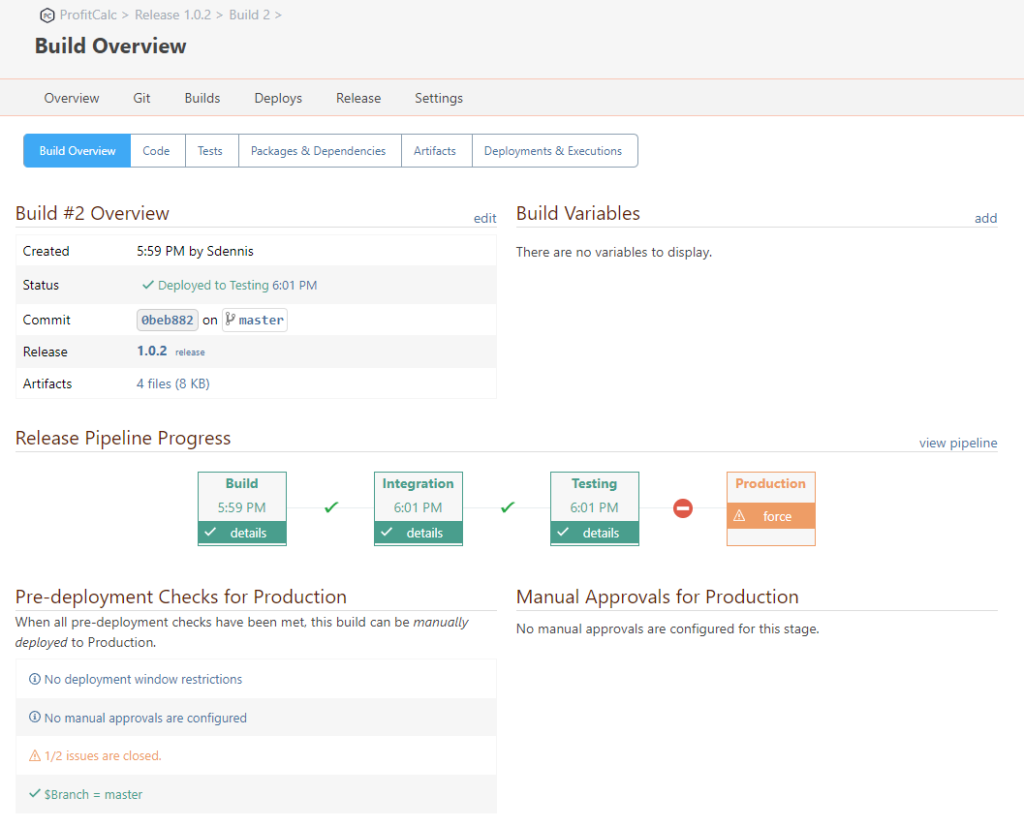
⭐ Piplines: Describe the repeatable process of moving code from one stage to the next. They’re designed to be stakeholder-friendly, offering more than just deployment status. Unlike typical CI/CD tools, BuildMaster pipelines visualize where the build stands and provide issue tracking, giving everyone a clearer view of the process.

Lean Platforms – Delivering Real-Time Information
Without real-time information (RTI), software supply chains experience delays, miscommunication, and inefficiencies. Organizations relying on disconnected tools often deal with siloed data and blind spots, causing bottlenecks that impact software quality, timelines, and customer satisfaction.
BuildMaster solves this by centralizing real-time data from existing tools into one easy-to-use command center. With source control, CI/CD, and issue tracking all connected, teams gain the alignment and predictability needed to reduce bottlenecks and deliver software reliably, the foundation of Lean Platforms.
Without the real-time information that Lean Platforms provides, you’ll only fall further behind as delays and miscommunication pile up. Got your attention? Good. RTI is just one of the tenets of Lean Platforms. To learn more, such as Dual Cadence Releases, Issue Tracking and Backlog Elimination, sign up for our free upcoming eBook Lean Platforms: Engineering and Orchestration.
Want to discover how Lean Platforms allows you to roll out innovative updates to your applications while keeping stability and speed intact? Schedule a chat with one of our experts today!
